How Manufacturing Automation Is Reshaping Canadian Production Facilities
Canadian manufacturing has always had to solve a slightly harder version of the production puzzle. Plants here often serve a wide geography, face higher logistics costs, deal with regional labour shortages, and operate under stricter energy, safety, and traceability expectations than many people outside the sector realize. Add pressure from global competition, customer demands for shorter lead times, and the steady unpredictability of input costs, and it becomes clear why manufacturing automation is no longer treated https://www.syncrobotics.ca/careers/ as a nice-to-have capital project. In many facilities, it has become the practical route to staying competitive.
That shift is visible across food processing lines in Ontario, metal fabrication shops in Alberta, packaging operations in Quebec, and advanced component manufacturers in British Columbia. Automation does not always arrive as a dramatic lights-out facility with robots everywhere. More often, it shows up as a series of smart, targeted decisions: a vision system added to reduce inspection errors, a robotic cell installed to handle repetitive welding, a conveyor redesign tied into sensors and PLCs, or a plant-wide data layer that gives supervisors real-time visibility into downtime.
Those changes are reshaping not just output, but how Canadian production facilities are staffed, maintained, expanded, and managed.
The pressure behind the shift
For years, many manufacturers delayed automation because legacy lines still ran well enough, margins were acceptable, and experienced operators could compensate for inefficient processes. That tolerance has narrowed. Across much of Canada, manufacturers now face a tighter labour market, especially for skilled trades, maintenance technicians, and experienced line operators. In some regions, the issue is not just cost. It is availability.
When a plant cannot reliably fill second shift roles, the economics of factory automation start looking different. A robotic palletizer that once seemed expensive becomes easier to justify when overtime, injury exposure, and staffing instability are factored in. The same is true for automated inspection. Human inspectors can do excellent work, but consistency drops when throughput increases and fatigue sets in. A well-tuned camera system paired with clear reject logic often improves both quality and traceability.
Canadian facilities also face a particular challenge around scale. Many are medium-sized operations, not massive mega-plants with unlimited capital budgets. That reality has shaped the kind of industrial automation solutions being adopted. Instead of full greenfield redesigns, companies are often pursuing modular upgrades that can be integrated into existing lines with manageable disruption. That practical, staged approach is one of the defining features of industrial automation Canada is seeing today.
What automation looks like on the plant floor now
Automation used to mean a fairly narrow set of technologies in the public imagination: robotic arms, conveyor belts, and control cabinets. Those are still part of the picture, but modern automation systems are far broader. The most successful projects combine mechanical handling, sensing, controls, software, and production data in a way that fits the actual rhythm of a facility.
A food packaging plant, for example, may automate end-of-line case packing and palletizing first, not because it is the flashiest application, but because that is where repetitive strain injuries, labour turnover, and bottlenecks are most obvious. A machine shop may begin with CNC integration and automated material handling rather than jump straight to collaborative robots. A plastics processor might prioritize closed-loop process control to reduce scrap and stabilize quality before investing in fully automated downstream packaging.
That sequencing matters. Good automation is rarely about buying the most advanced equipment available. It is about removing the highest-cost constraint in a process, then making sure upstream and downstream operations can support the gain.
In Canadian plants, four areas tend to drive the strongest early returns:
- Robotic handling for repetitive, hazardous, or ergonomically difficult tasks
- Machine vision for inspection, counting, and traceability
- Control upgrades for legacy equipment and process stability
- Data collection for downtime tracking, maintenance planning, and scheduling
- Automated packaging, palletizing, and internal material movement
Even within those categories, the practical details matter more than the labels. A robotic cell that saves labour but adds twenty minutes of changeover to each product run can hurt overall throughput in a high-mix facility. A vision system that performs well in lab conditions may struggle under washdown lighting or with reflective materials. An MES layer that floods supervisors with dashboards but does not improve response times can become shelfware with a subscription fee.
The plants getting the best results are not necessarily the ones automating the fastest. They are the ones integrating carefully.
Legacy equipment is not going away, and that changes the strategy
Many Canadian production facilities are running a blend of old and new equipment. It is common to see a modern robotic work cell installed next to a machine that has been on the floor for twenty years. That is not a flaw. It is how real manufacturing investment works. Capital gets deployed in phases, and useful assets stay in service as long as they perform.
The implication is that industrial automation solutions in Canada often revolve around interoperability. New controls must communicate with older machines that were never designed for open data exchange. Safety systems need updating without creating unnecessary downtime. Sensors and drives may need to be retrofitted into cabinets with limited space and outdated documentation.
This is where strong engineering makes a visible difference. Retrofitting a line is often harder than building from scratch because every compromise from previous decades is still hiding in the system. Cable runs are undocumented, pneumatic logic has been modified over time, and original OEM support may no longer exist. Plants that underestimate these realities can see project timelines stretch quickly.
That said, retrofits can produce some of the most compelling returns. A controls modernization project that replaces obsolete hardware, adds remote diagnostics, and improves line synchronization can extend the productive life of a line by years. In facilities where margins do not support a complete equipment replacement, this kind of targeted automation is often the difference between gradual decline and renewed competitiveness.
Labour is changing, not disappearing
One of the laziest narratives around manufacturing automation is that it simply removes people from the equation. On actual production floors, the story is more nuanced. Some manual tasks do disappear, especially those that are repetitive, dirty, dangerous, or difficult to staff. But the labour profile of a plant usually becomes more technical, not less human.
A plant that installs automation systems still needs operators, setup staff, quality personnel, electricians, mechanics, controls technicians, and supervisors who can respond intelligently when process variation appears. In fact, once automation is in place, the cost of poor troubleshooting often rises. When a manual station falls behind, an experienced operator may improvise a workaround. When an automated line trips repeatedly, upstream and downstream losses can compound fast.
This is why training is often the hidden determinant of whether automation pays off. Some facilities buy sophisticated equipment but budget lightly for operator development and maintenance support. The result is predictable. Performance drifts, nuisance faults increase, and staff begin bypassing features they do not trust. On paper, the automation exists. In practice, the line runs below its potential.
The better approach is to treat workforce development as part of the automation investment itself. That means vendor training, cross-training across shifts, clear escalation procedures, and documentation that reflects the line as built, not just as sold. It also means involving experienced floor staff early. Operators often know where jams occur, where product varies, and which “small” manual adjustments keep quality stable. Ignoring that knowledge is one of the most expensive mistakes in automation projects.
I have seen lines where one veteran operator could tell, from a slight change in machine sound, that a feeder issue was developing long before any alarm appeared. When those people are included in project planning, automation gets better. When they are sidelined, problems arrive later and cost more to solve.
Quality, traceability, and compliance are becoming stronger drivers
Cost reduction gets most of the attention in discussions about factory automation, but in Canada, quality and compliance are often equally important. This is especially true in food and beverage, pharmaceuticals, medical devices, aerospace, and automotive supply chains, where documentation and repeatability are not optional.
Automation helps here in several ways. It standardizes process parameters, records operating conditions, and reduces variation introduced by manual handling. Vision systems can confirm labels, seals, dimensions, and presence or absence of components at speeds no human team could maintain consistently over a long shift. Data logging supports root-cause analysis when defects emerge. Recipe management reduces the risk of incorrect settings during product changeovers.
For facilities supplying regulated sectors, that traceability has become central. Customers increasingly expect not just a conforming part or packaged product, but a reliable digital record of how it was produced. If a supplier cannot provide that confidence, especially under audit pressure, its position in the supply chain weakens.
There is also a less discussed quality benefit. Automation can make process drift visible earlier. In a manual environment, a line may stay “good enough” until scrap levels or customer complaints rise. In an automated environment with proper monitoring, slow deterioration in cycle time, fill weight, temperature stability, torque, or alignment becomes easier to detect. That allows intervention before losses multiply.
Energy and uptime now belong in the same conversation
Canadian manufacturers are paying closer attention to energy intensity, not just because of sustainability targets, but because utilities and operating costs affect competitiveness directly. Automation intersects with this issue more than many assume.
Modern drives, motors, control strategies, and process optimization tools can reduce wasted motion and idle run time. Compressed air usage can be monitored more effectively. Heating and cooling loads tied to production equipment can be managed with greater precision. Batch processes can be tuned to avoid unnecessary overprocessing. Even small improvements matter at scale, especially in facilities running long hours.
At the same time, uptime remains king. A plant does not become more competitive simply by adding automation if that automation is fragile or poorly supported. The strongest projects improve overall equipment effectiveness through better fault visibility, predictive maintenance signals, and faster changeovers, not just higher nominal machine speed.
This is one reason why remote monitoring and diagnostics have gained traction. For plants in smaller centres, where specialized controls expertise may not be on site at all times, the ability to access machine data quickly can shorten troubleshooting dramatically. That capability has become especially valuable in a country where technical support may otherwise involve flights, weather delays, or long drives between industrial regions.
The economics are real, but they are not uniform
It is tempting to talk about automation as though every project delivers an obvious payback. Reality is less tidy. The economics depend heavily on process stability, product mix, available labour, existing equipment condition, and the discipline of project execution.
A high-volume, repetitive line with chronic staffing pressure may justify automation quickly. A low-volume, high-mix operation with frequent custom work may need a much more selective approach. In some shops, the right answer is not a robot but better fixtures, improved scheduling, or semi-automated handling that reduces strain without overcomplicating production.
Canadian manufacturers also have to account for financing conditions, exchange rates, import lead times, and installation timing around seasonal production cycles. A piece of equipment may look attractive in a spreadsheet, but if it arrives nine months late and misses the only shutdown window available, the business case changes. So does the picture if line-side infrastructure upgrades, guarding, utility work, and training were underestimated in the original estimate.
That is why the best capital planning around industrial automation canada wide tends to focus on total system cost and operational fit, not just sticker price. Management teams that ask only, “How much labour does this remove?” are often asking too narrow a question. Better questions include: Does this reduce our biggest constraint? Can we maintain it? Will it improve first-pass yield? How does it affect changeover? What happens on night shift when it faults?
Small and mid-sized manufacturers are finding a different path
Large multinational plants have long invested in automation. What is more interesting now is how many small and mid-sized Canadian manufacturers are entering the space with sharper, more disciplined projects. They are not trying to automate everything. They are targeting pain points with measurable consequences.
Often that starts with one well-chosen application. A custom fabricator may automate welding on a family of repeat parts while keeping manual flexibility for short runs. A packaging company may install cobots at the end of the line where cartons are heavy and turnover is high. A processor may connect machines to a basic production monitoring system to understand stops before making mechanical changes.
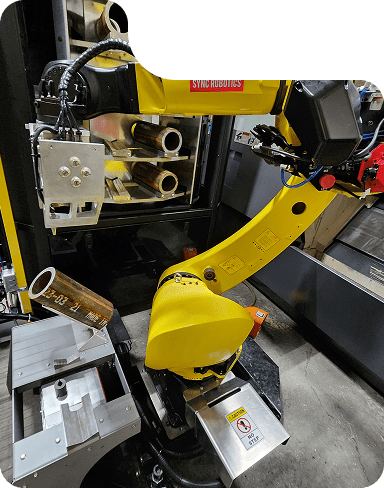
This more incremental path has advantages. It limits disruption, builds internal confidence, and lets teams develop the habits needed to run more automated operations. It also exposes whether the plant is ready for deeper adoption. Sometimes the first automation project reveals issues that have nothing to do with robotics or controls, inconsistent incoming materials, weak preventive maintenance, poor part presentation, unclear standard work. Fixing those basics often multiplies the value of later investments.
One practical sign of maturity is when a plant stops treating automation as a standalone engineering purchase and starts treating it as an operations strategy. At that point, discussions widen. Layout, material flow, quality systems, maintenance practices, cybersecurity, spare parts, and staffing models all enter the room. That is when projects tend to scale successfully.
Integration risk is where many projects live or die
Buying a machine is easy compared with integrating it into real production. This is the point where optimistic assumptions usually meet the plant floor.
Successful automation systems depend on more than hardware performance. Product presentation has to be repeatable. Line balancing has to make sense. Reject handling must be thought through. Safety logic cannot become so cumbersome that operators start fighting the system. Changeovers need to be practical for the actual crew on shift, not just for the commissioning team during startup week.
There is also the issue of ownership. When automation is bolted onto a process without clear internal responsibility, support gaps appear quickly. Operations thinks maintenance owns it. Maintenance thinks engineering owns it. Engineering assumes the integrator will keep solving issues indefinitely. Meanwhile, line performance drifts.
Plants that avoid this trap usually do a few things well:
- They define success in operational terms, not just installation milestones
- They involve operations, maintenance, quality, and safety early
- They budget for debugging, training, and post-startup support
- They insist on documentation and spare parts planning before handoff
None of that is glamorous, but it reflects how durable automation is actually built. The facilities that get real returns are often the ones that sweat these details.
Canadian sectors are adopting at different speeds
The pace and style of manufacturing automation differ by sector. Food and beverage plants often move toward automated packaging, vision inspection, and sanitary handling systems first because throughput, traceability, and labour stability dominate the business case. Automotive and related suppliers continue investing heavily in robotics, in-line verification, and coordinated automation systems because cycle time discipline and customer quality expectations leave little room for inconsistency.
Wood products and building materials manufacturers have their own priorities, often focused on ruggedized automation that can withstand dust, variable raw materials, and difficult environments. Metals and fabrication shops frequently balance CNC sophistication with practical material handling improvements and welding automation. Pharmaceutical and medical manufacturing tend to focus on validation, repeatability, and data integrity from the outset.
The point is not that one sector is “ahead” in some generic sense. It is that good automation reflects production reality. The best projects are grounded in the physical and commercial constraints of the facility, not in a trend report.
What the next phase is likely to look like
Over the next several years, Canadian production facilities will probably continue moving toward more connected, modular, and data-aware operations. That does not mean every plant will become fully autonomous. Most will remain mixed environments where people and machines share responsibility. But the baseline expectation is changing.
Customers will expect better traceability. Owners will expect tighter uptime and labour utilization. Workers will expect safer, less punishing tasks. Maintenance teams will expect clearer diagnostics. Managers will expect data that helps them make decisions before a shift is lost.
The manufacturers that respond well will not be the ones chasing every new technology label. They will be the ones with enough operational discipline to choose the right application, integrate it cleanly, train their people properly, and keep improving after startup. In that sense, manufacturing automation is not replacing manufacturing judgment. It is raising the value of it.
For Canadian facilities, that may be the most important shift of all. Automation is no longer just about mechanizing tasks. It is becoming the framework through which plants design resilience, protect quality, and compete in markets that leave less room each year for inefficiency.
Sync Robotics Inc. — Business Info (NAP)
Name: Sync Robotics Inc.Address: 2-683 Dease Rd, Kelowna, BC V1X 4A4
Phone: +1-250-753-7161
Website: https://www.syncrobotics.ca/
Email: [email protected]
Sales Email: [email protected]
Hours:
Monday: 8:00 AM – 4:30 PM
Tuesday: 8:00 AM – 4:30 PM
Wednesday: 8:00 AM – 4:30 PM
Thursday: 8:00 AM – 4:30 PM
Friday: 8:00 AM – 4:30 PM
Saturday: Closed
Sunday: Closed
Service Area: Kelowna, British Columbia and across Canada
Open-location code (Plus Code): VHWR+PQ Kelowna, British Columbia
Map/listing URL: https://maps.app.goo.gl/xwtV2wEu8ZuKH3se8
Embed iframe:
Socials (canonical https URLs):
LinkedIn: https://www.linkedin.com/company/syncrobotics/
Instagram: https://www.instagram.com/syncrobotics/
Facebook: https://www.facebook.com/syncrobotics/
https://www.syncrobotics.ca/
Sync Robotics Inc. is an industrial robot and controls integration company based in Kelowna, British Columbia.
The company designs and deploys automation solutions for manufacturing operations across Canada.
Services include industrial robotics integration, controls integration, automation system design, deployment support, and related manufacturing automation solutions.
Sync Robotics Inc. is located at 2-683 Dease Rd, Kelowna, BC V1X 4A4.
To contact Sync Robotics Inc., call +1-250-753-7161 or email [email protected].
For sales inquiries, email [email protected].
Hours listed are Monday to Friday 8:00 AM–4:30 PM, with Saturday and Sunday closed.
For directions and listing details, use the map listing: https://maps.app.goo.gl/xwtV2wEu8ZuKH3se8
Popular Questions About Sync Robotics Inc.
What does Sync Robotics Inc. do?Sync Robotics Inc. designs and deploys industrial robot and controls integration solutions for manufacturing operations.
Where is Sync Robotics Inc. located?
Sync Robotics Inc. is located at 2-683 Dease Rd, Kelowna, BC V1X 4A4.
Does Sync Robotics Inc. serve clients outside Kelowna?
Yes—Sync Robotics Inc. is based in Kelowna, British Columbia and serves clients across Canada.
What are Sync Robotics Inc.’s hours?
Monday–Friday: 8:00 AM–4:30 PM; Saturday and Sunday closed.
How can I contact Sync Robotics Inc.?
Phone: +1-250-753-7161
General Email: [email protected]
Sales Email: [email protected]
Website: https://www.syncrobotics.ca/
Map: https://maps.app.goo.gl/xwtV2wEu8ZuKH3se8
LinkedIn: https://www.linkedin.com/company/syncrobotics/
Instagram: https://www.instagram.com/syncrobotics/
Facebook: https://www.facebook.com/syncrobotics/
Landmarks Near Kelowna, BC
1) Kelowna International Airport2) UBC Okanagan
3) Rutland
4) Orchard Park Shopping Centre
5) Mission Creek Regional Park
6) Downtown Kelowna
7) Waterfront Park